

All of this is false, WhatsApp has also denied it and we want to tell you that we do not verify or censor content for WhatsApp and what the measure that the platform has promoted worldwide consists of. It is another hoax from a campaign in which we have carried out more than 400 debunks and that we now have to suffer ourselves. We explain it to you. And we ask for your support. Share.
Are contents being censored on WhatsApp?
No content is being removed, nor is anyone; no entity or person is controlling, verifying or censoring what messages you send on WhatsApp. There are no people behind it seeing what is or is not real. The new feature from WhatsApp is a limitation on the number of people to whom a message that had already been forwarded more than 5 times before reaching you can be forwarded, regardless of its content. In a statement WhatsApp notes that "The new global forwarding limit was implemented by WhatsApp to keep the service personal and private, and to reduce the spread of viral messages, with the aim of keeping our users safe. It is in no way related to fact-checking organizations or to ‘censorship’, and any claim suggesting otherwise is 100% false."
What does this WhatsApp measure consist of?
WhatsApp has taken a measure to reduce the spread of all types of content that had been forwarded more than 5 times before reaching you. It is not a restriction on some content and not others.
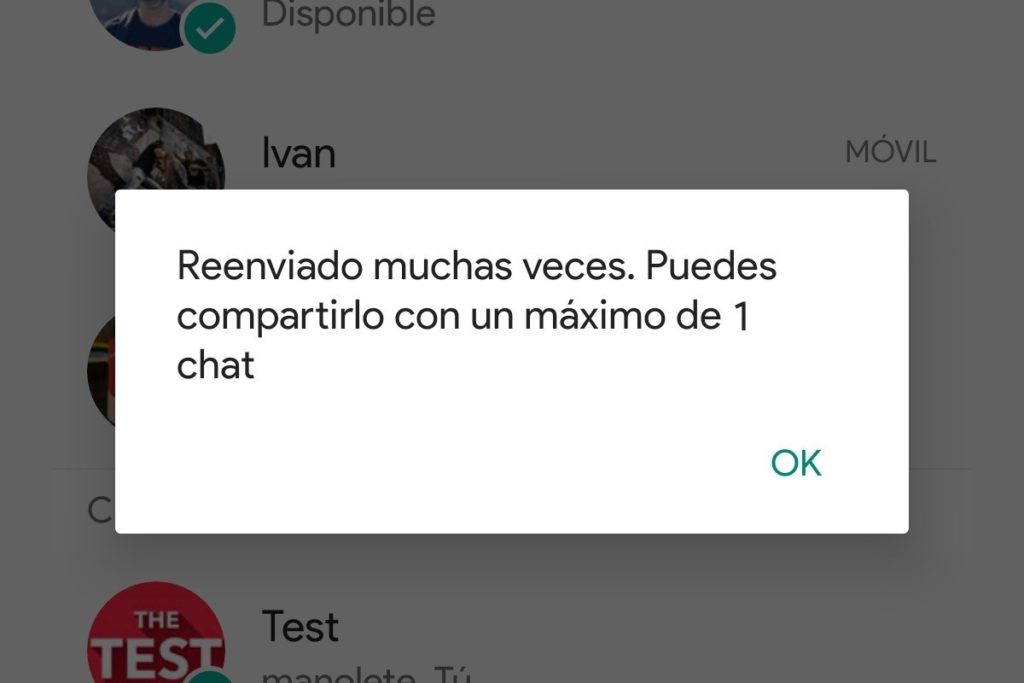
WhatsApp limits the forwarding of those messages that had already been forwarded more than 5 times before reaching you and thus "restrict the viralization" of some of them that could be spreading disinformation, especially in the current context of the coronavirus emergency. Therefore, some messages will only be able to be forwarded to one chat at a time and not to several at once.
Does the WhatsApp measure affect only political content?
As we tell you, no. It is not aimed at political content but at all types of content that had been forwarded more than 5 times before reaching you. It is not a restriction on some content and not others because neither the platform nor anyone other than the sender and the recipient of the message can see the content of a message. The company notes in its statement that "this limit is automatically applied and is in no way related to the content of the message -which WhatsApp neither sees, nor moderates, nor censors – because all WhatsApp messages and calls are protected with end-to-end encryption."
Why does it let me forward some messages and not others?
WhatsApp categorizes forwarded messages into two types: those that a contact has sent you but that had not previously been forwarded many times, which we can see with a small arrow above them, and those that, before reaching your phone, had been forwarded at least five more times. These are accompanied by a double arrow label that also "indicates that they were not created by a close contact" and, therefore, it is unlikely that they come from your contact list (whom you will at least know a little better).
This last category is the one WhatsApp is limiting with its new rule. Until now, all forwarded messages could be forwarded again to a maximum of five contacts at a time. This was one of the first measures taken by the messaging network to prevent content that could be false from going viral, and now it goes a step further by limiting it to only one at a time if it had previously been forwarded more than 5 times.
Can WhatsApp see the content of my messages?
According to WhatsApp, messages are encrypted and therefore only the sender and the recipient can see their content: no one reads what you send or receive and, therefore, no one can censor it.
Due to end-to-end encryption on WhatsApp, the company assures that only you and the recipient can read what is sent, and that no one else, not even WhatsApp, can do so. All this happens automatically, without the need to activate settings or create special secret chats to secure your messages. End-to-end encryption is always active. There is no way to disable or turn off end-to-end encryption.
Is this measure only in Spain?
The forwarding limitation is one of the measures that WhatsApp has launched worldwide to limit the forwarding of those messages that had already been forwarded more than 5 times and thus "restrict the viralization" of some of them that could be spreading disinformation, especially in the current context of the coronavirus emergency.
Is the government censoring content on WhatsApp?
The Government has nothing to do with this: it is a worldwide decision by the company and it is an automatic WhatsApp process.
Is Maldita.es or someone verifying for WhatsApp? Why is there a WhatsApp page where your number appears?
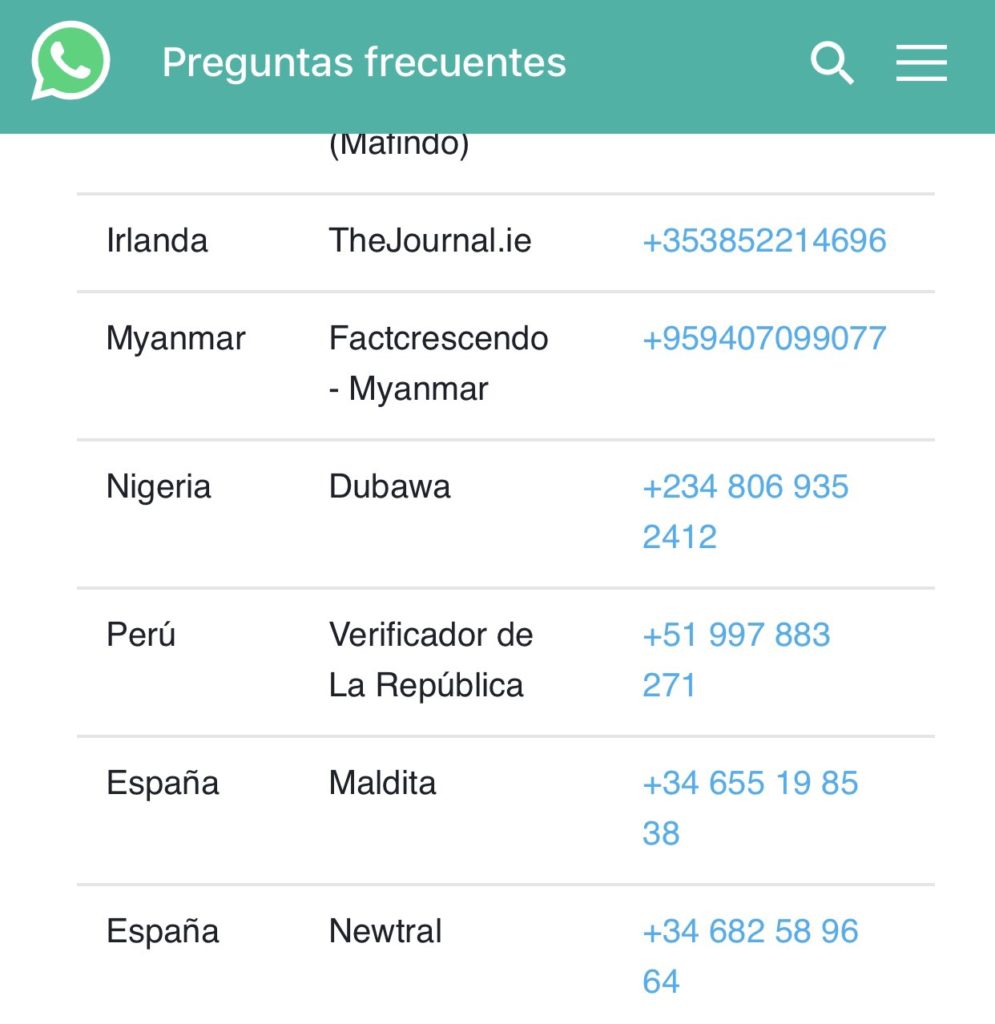
We are not verifying content for WhatsApp: we do not have access to the content that is going viral. In the WhatsApp FAQs our number appears, along with dozens of other fact-checkers around the world as a recommendation of where you can verify “if the data you receive seems suspicious or inaccurate”. All the organizations that appear on that list are signatories of the Code of Principles of the International Fact-checking Network (IFCN). It is a recommendation that WhatsApp makes so that you consult fact-checkers that belong to the International Fact Checking Network. WhatsApp tells you that if the data you receive seems suspicious or inaccurate, “we recommend” verifying it with these official IFCN fact-checking organizations. And it provides our phone numbers. That’s it. We do not verify for WhatsApp.
What is the International Fact-checking Network (IFCN)?
The International Fact-checking Network is an organization committed to excellence in journalistic verification processes that monitors, worldwide, that the teams dedicated to this do so in compliance with a series of ethical principles that guarantee the impartiality and professionalism of their debunks.
To be signatories of its Code of Principles and belong to this alliance, Maldita.es each year passes an examination in which an independent assessor evaluates our compliance with said Code of Principles, and subsequently that evaluation is ratified by the IFCN Advisory Board.
Here you can read more about the Code of Principles and the entities that belong to the IFCN worldwide.
What does Maldita.es do on WhatsApp?
We have a phone number where you can consult us about that possible hoax you receive: 655198538. You send us the content that seems suspicious to you and we carry out a verification according to our methodology and subsequently publish it on our website. That verification we carry out in no way affects the content circulating on WhatsApp: it neither removes it, nor censors it, nor anything. We do not have any kind of access to WhatsApp, we can only debunk on our website the content that users send us.
In addition, here you can sign up to receive a list of what we have debunked that we send every afternoon.
What does Maldita.es do on Facebook?
Maldita.es reached an agreement in March 2019 with Facebook in the Third-Party Fact-Checking Program: an initiative that Facebook launched after the rise of disinformation in the 2016 US elections to combat the hoaxes circulating within its platform. Since then, the program has been launched in dozens of countries in collaboration with verification teams certified by the International Fact-Checking Network.
Maldita.es, like other fact-checkers in our country such as Newtral and AFP, verifies content within the platform according to our methodology. Subsequently, Facebook carries out a series of measures that in no case involve the deletion of said content. You can read more about this program here.