
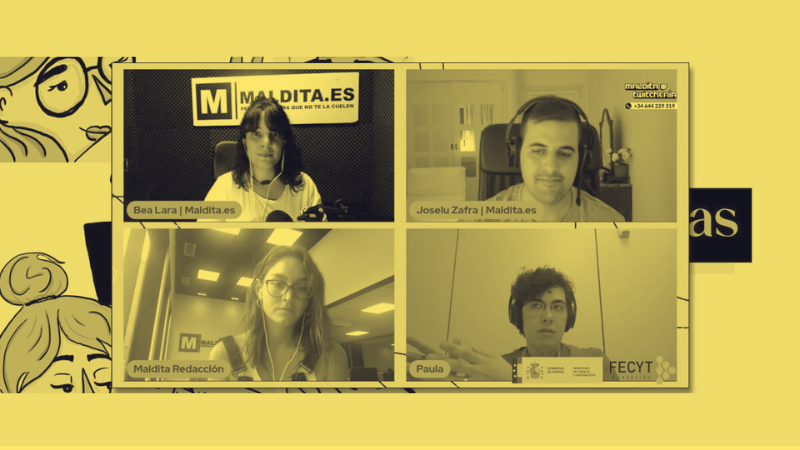
Last Thursday, September 15, we streamed a Maldita Twitchería broadcast featuring all the protagonists of this project. On one side, four of the five Superpowered Women who appeared in the launch video — Mercedes González, Myriam Catalá, Alicia Bayón and Paula González — and on the other, the heads of Maldita Educa, Laura del Río; Maldita Tecnología, Naiara Bellio; and Maldita Academia, Pablo Hernández Escayola. Finally, we were joined by Anabel Forte, statistics researcher and a leading figure in Spanish-language mathematics outreach.
Alicia Bayón: “If the goal is to debunk a hoax and explain science to everyone, the effort-benefit ratio is infinite”
Bayón is a chemist, an expert in the use of hydrogen in renewable energy, a Maldita.es collaborator who has shared her knowledge in multiple articles (such as this one or this one), and one of the faces of the Superpowered Women campaign video. She explains that she decided to join the Maldita.es community during the first weeks of the COVID-19 lockdown, as people close to her “believed many hoaxes, and I no longer knew how to explain that most of what was circulating was false”. Disinformation about climate change, because of her profession, also bothers her.
Mercedes González: “During the lockdown, I needed to contribute something against hoaxes, and that’s when I decided to take part”
González, also featured in the Superpowered Women campaign, is a veterinarian who has shared her superpowers with us to explain zoonoses (diseases that can be transmitted from animals to humans). From her point of view, before the SARS-CoV-2 pandemic, the role of veterinarians was not well known beyond vaccinating pets. “We are in farms, with companion animals and wildlife, constantly putting barriers in place to prevent diseases from jumping from animals to humans,” she explains.
Myriam Catalá: “Diversity is essential. If information comes from only a few sources, it is very easy to manipulate or bias it”
The news that Catalá would be one of the faces of the Superpowered Women campaign surprised everyone around her. “I still haven’t finished replying to all the WhatsApps,” she joked during the live stream. The biochemist, who collaborates with Maldita.es, works in a biodiversity research unit where she is well aware of the problems that arise when working in homogeneous groups without different perspectives, such as those of women experts. She believes universities have partly lost contact with the information society needs, something she regrets, because universities build knowledge “with rigor and many controls”, although they are not free from problems, including a lack of diversity.
Malu Sáenz: “I loved working on this project because I was given freedom”
Malu Sáenz, designer at Maldita.es, was responsible for giving the Superpowered Women project its visual identity. Together with community coordinator Bea Lara, she worked from hand-drawn sketches to define the illustrations for the campaign, choosing the colors and the appropriate typography. Before illustrating the ideas, she researched which women are usually consulted in Maldita.es articles and covered the main areas of knowledge. In her opinion, illustrations can be used “much more, even if that means more work”.
Diversity and impostor syndrome in the technology field
Paula González shares her superpowers in cybersecurity in Maldita Tecnología and Maldito Timo, and she is now also one of the recognizable faces of the Superpowered Women campaign. She is an example that contributors do not need to come only from universities or research centers: companies and private organizations can also contribute greatly to the fight against disinformation.
She is convinced that diversity is positive: “Each person’s mindset does not depend only on what we have learned, but also on the experiences we carry with us”. “If you include men and women, people from different countries, different backgrounds… you will have more ways of thinking that lead to better solutions.”
At this point in the Twitch stream, Naiara Bellio, coordinator of Maldita Tecnología, joined the conversation and pointed out that many women “think they are not qualified to explain certain things, not because they do not know, but because they say it is not their field or that they are not completely sure, even though they know far more than a journalist or the general public”.
Academia: scientific research with the Maldita.es community and surveys
Along with the Superpowered Women project, the grant Maldita.es has received from the Spanish Foundation for Science and Technology (FECYT) includes scientific research to find out whether the work we do debunking hoaxes is effective. Part of this involves understanding the community and involving it in the fight against disinformation. “Researchers from universities in the United States who study disinformation, such as Georgetown or MIT (Massachusetts Institute of Technology), are very interested in the community; they find the project fascinating,” explains Pablo H. Escayola, head of Maldita Academia.
The project also includes adding surveys to articles to understand how effective they are in preventing hoaxes and where improvements are needed.
Bringing Superpowered Women into classrooms
As with Academia, another part of the project is bringing Superpowered Women into the schools visited by Maldita Educa. In this way, explains coordinator Laura del Río, “girls will see that there are women role models working in science in all its fields”. Although students of this age do not usually consume traditional media, they still receive information — and disinformation — “through Instagram, TikTok and other social networks”, which is why media literacy in classrooms is so important.
Anabel Forte: “Science needs role models, especially close ones, not only Marie Curie”
The statistics professor from the University of Valencia joined the Superpowered Women Twitch stream to highlight the importance of role models who inspire other women and girls to pursue science. “Above all, close role models, not only Marie Curie, who is the ultimate reference with two Nobel Prizes.” Her own role models were Pilar, her mathematics teacher, “a fundamental pillar in how she taught me the subject”, and her PhD supervisor Susie Bayarri, “a source of inspiration”.
We also used the broadcast to talk about her recently published book, How to Survive Uncertainty? (Next Door Publishers).