

At Maldita.es we have debunked more than 700 hoaxes and published more than 1,100 explanatory articles about COVID-19. The battle against pseudoscientific nonsense and health disinformation is today more relevant than ever: we believe that critical thinking and education are the best long-term cure, but while they arrive, journalism —with the help of the community— is the best vaccine to prevent lies from spreading.
In the face of lies that attack public health, journalism is not about interviewing “both sides”
Journalism has a responsibility in how it carries out verification: it cannot give the same weight to those who spread the hoax as to those who debunk it with data, facts and knowledge based on scientific evidence.
Interviewing a spreader of nonsense and then a scientist specialized in that area of knowledge means placing both at the same level in the argument, giving the former a weight they do not deserve and, in doing so, giving more visibility to their unfounded theories.
Journalism must be responsible and not give a platform to those who spread these hoaxes. On Friday 31 July, the Telediario of TVE included statements by Natalia Prego, known for spreading false information about the pandemic, and then debunked them with statements by Juan Antonio López Guerrero, biologist and science communicator.
On 31 August Espejo Público interviewed Pilar Baselga, known conspiracy theorist and epidemic denier. The program used our debunks, but after years dedicated to this, we can say that lies should not be given a loudspeaker. That same day Baselga also appeared on the program Todo es Mentira.
On 8 September, the Telediario of TVE mentioned the alert from the Toxicological Information Service about the consumption of MMS, a toxic compound that does not cure COVID-19 (or anything), but included in its piece statements by Josep Pamiés, known for promoting its use against all scientific evidence. Pamiés has been sanctioned by the Generalitat for promoting the use of pseudotherapies to cure diseases.
Coronavirus conspiracy theorists and deniers are advancing and their lies must be stopped
Many of these hoax spreaders question social distancing measures, the origin of the virus, the usefulness and safety of masks, a key object in the fight against the pandemic. These doubts put us all at risk. Since confinement began, masks in particular have been the protagonists of countless hoaxes distributed millions of times on different platforms.
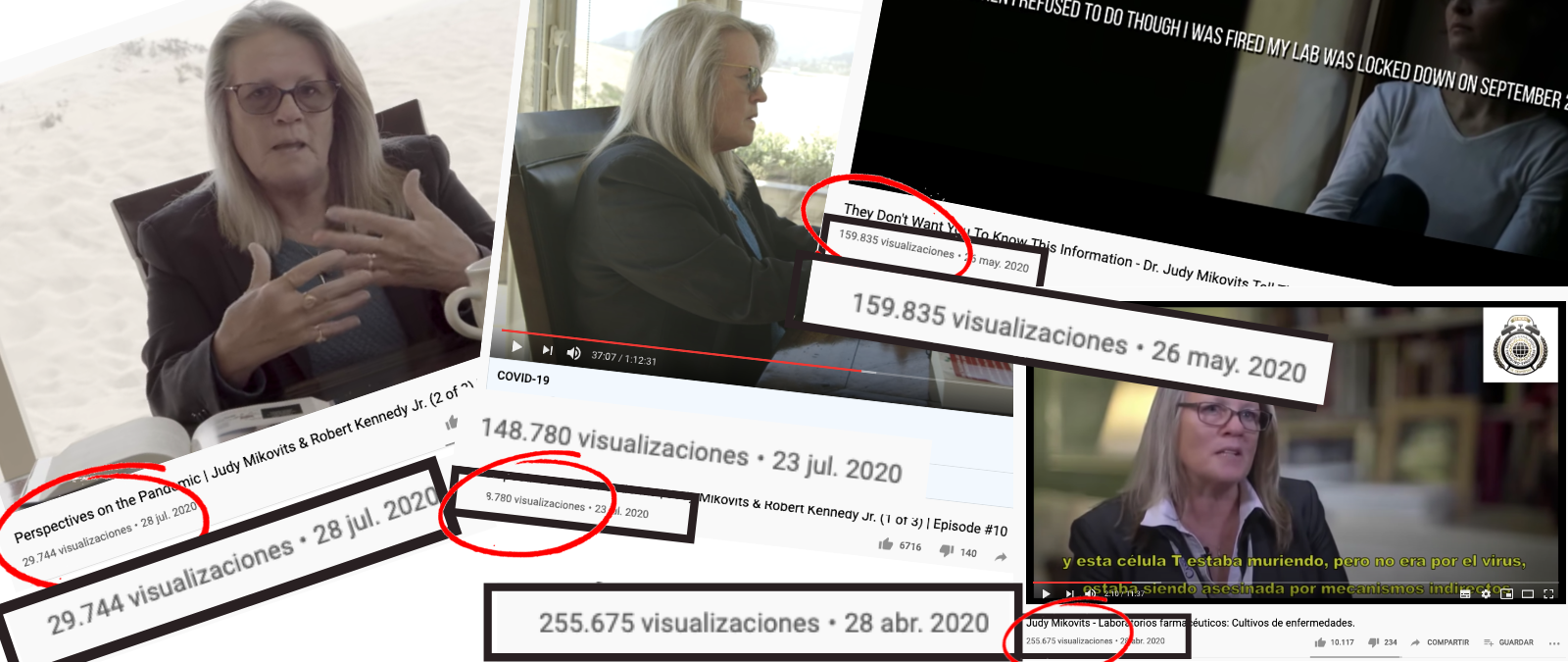
For example, those spread by Judy Mikovits. Mikovits was the protagonist of three viral videos full of falsehoods about the coronavirus, masks, vaccines (here we debunked one, here another and here the third). Perhaps her name does not ring a bell and you may think that by dismantling the falsehoods she says we are giving them more visibility, that it would be better to ignore her completely. But by searching her name on YouTube we find that those two videos, and others in which she repeats the same false conspiracy theories, have together hundreds of thousands of views.
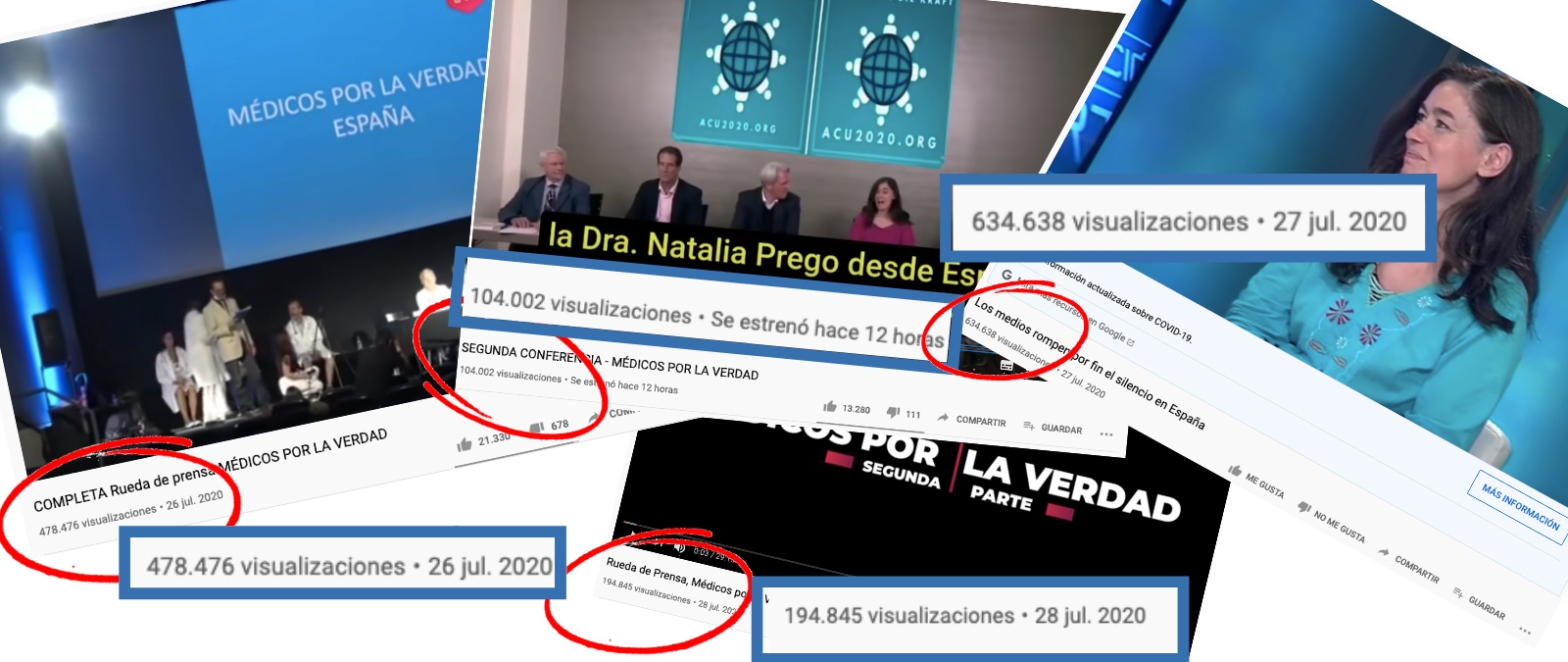
The same happens with the denialist association Médicos por la verdad: both their videos, and those in which only one of their spokespersons, Natalia Prego, appears, add up to hundreds of thousands of views on YouTube and shares on Facebook.
Evidence that fact-checking works exists
The fact that some people do not encounter them on their networks does not mean that they only reach very small groups, but rather that on social networks each of us lives inside our bubble and perhaps we are not coming across them.
Precisely the objective of fact-checking is to serve as a brake on their expansion. We know that there are people whom facts, data and explanations will never convince. The reality is that they are influencing people who are not positioned, but who, if they only receive hoaxes and not data and facts, may end up believing the lies.
There are several scientific studies and experiments that show that correcting these errors works. In 2017 two researchers from Georgetown and George Mason universities carried out an experiment around disinformation about the Zika virus in Brazil and the effect that debunks about it had on Facebook users. The conclusion? That they are effective “to limit misperceptions, and correction occurs for individuals with both high and low conspiracy beliefs.”
The usual argument is that fact-checking triggers confirmation bias in users. Whether we are talking about politics or pseudoscience, there is a belief that when you tell someone that the nonsense they believed is false, you are actually helping to confirm their beliefs and that therefore verification is useless. Again, there is available academic evidence pointing to the contrary.
In an experiment carried out in 2016 around this idea of confirmation bias, 8,100 subjects were exposed to fact-checks made about politicians on 36 different topics. Only one of those 36 verifications triggered a backfire effect. The researchers’ conclusion was that "in general, citizens pay attention to factual information, even when that information challenges their partisan and ideological commitments." And it is not the only one. More examples here, here and here.
Verification as a vaccine
If we do not debunk them, if we do not appear in that search for truth, those who spread disinformation will end up convincing more and more people. Or at least creating doubts as a result of the conspiratorial bombardment.
Our objective is that alongside their hoaxes there is verified information to vaccinate us against them and the sooner the better. If our debunk reaches you before the hoax, we will have gained ground.
The most effective vaccine against lies is not us: it is critical thinking and citizens’ education in handling solid and reliable information. But that is a process that will take longer. Meanwhile, fact-checking journalism together with the community are key to putting a stop to hoaxes.
In the face of hoaxes: verification during the pandemic
At Maldita.es we have worked hard during the pandemic and that translates into more than 700 hoaxes debunked about all aspects related to the disease, the state of alarm, deconfinement, the political perspective, etc. But adding up all the explanatory articles we have published in these months, the figure exceeds 1,100. They are all collected in this special.
We have done this with the help of the maldita community, which has sent us the doubtful content it has found on social networks or received via WhatsApp. Thanks to that and to the collaboration of experts and medical and scientific societies that have the knowledge to explain and transmit the most solid and reliable information with which to make better decisions, we can fight lies.
In addition, we have worked in different formats to reach as large an audience as possible: the weekly podcast Maldita la Hora, collaborations in media such as Telemadrid or Radio Nacional, and a street campaign with posters designed by the artists of Yo, Doctor placed on bus shelters in 55 Spanish municipalities to raise awareness about the correct use of masks against the coronavirus. We have also participated in workshops, talks and virtual seminars through our branch Maldita Educa, because we believe that education is the true cure against disinformation. Within this educational effort we have also launched the board game ¿Verdad o Bulo? Coronavirus edition.
Finally, we are aware that disinformation is not an exclusively Spanish problem, so we have joined forces with other fact-checkers. As a result of collaboration with European verifiers we have published a report on how disinformation has moved across Europe during the pandemic that you can consult here. We are also part of Latam Chequea, a union of 22 organizations in 15 Spanish-speaking countries to put a stop to the infodemic.
For all this we know that the fight against disinformation during the pandemic is being an important but delicate task and that if it is not done well it can have the opposite effect to the one we seek: giving disinformers more visibility than they already have. Journalism is the best way to win this battle against hoaxes, but being responsible and understanding that lies should not have a place in the public sphere.