
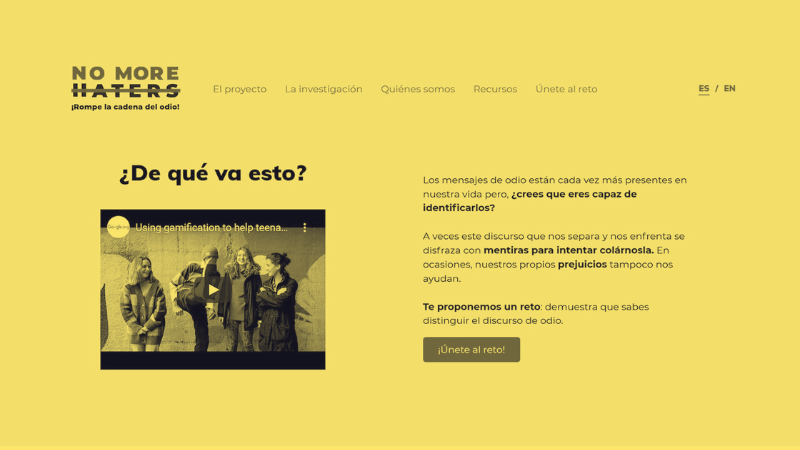
The project, which includes the website www.nomorehaters.es, involves carrying out a sociological study to understand the attitudes and positions of young people regarding hate speech online, as they are a group with very high use of the internet and social media, while also being especially vulnerable users.
The project also foresees the launch of an awareness campaign on social media aimed at young people; a guide for teachers to help them work on these topics in the classroom; and the design of a bilingual app, all focused on encouraging reflection, prevention, and action against expressions of hate and intolerance among teenagers and young people aged 14 to 29.
The goal is to provide adolescents and young people with tools so that they can become active participants in finding solutions and combating hate, promoting processes that help identify hate speech, overcome prejudice and stereotypes, encourage intercultural dialogue, and provide critical thinking tools for online interactions.
According to Fad’s Director General, Beatriz Martín Padura: “One of the main problems regarding hate speech is that many young people do not know how to identify it. They may not be aware that by sharing a meme that stigmatizes a group, for example, they are contributing to hate speech. It is important that we train them to identify and combat it because they live with these expressions of hate every day.”
For her part, Maldita.es co-founder Clara Jiménez Cruz said: “Disinformation dangerously fuels hate messages and has found in social media the ideal channel to reach younger audiences. These kinds of messages go against a plural, diverse and respectful education that we must achieve as a society. With this project, we hope that young people and teenagers develop critical thinking and learn to identify this kind of content.”
Hate speech on social media
Technology is part of social relationships, and access to the internet is as essential as the right to freedom of expression. However, taking advantage of anonymity or certain legal gaps, the online space has also become a setting for discrimination and harassment.
In Spain, data from the Ministry of the Interior show a steady annual increase in the number of recorded hate crimes, including hate speech online. In 2017, the number of hate crimes stood at 1,419; it grew by 12.6% to reach 1,598 in 2018, and in 2019 it rose to 1,706 cases, an increase of 6.8%.
In the most recent year, most incidents had an ideological motive (34.9%), followed by cases linked to racism and xenophobia (30.2%), and then sexual orientation or gender identity (16.3%). To a lesser extent, under 4.5%, there were cases of discrimination based on sex or gender, religion, disability, illness, aporophobia, anti-Roma discrimination, or antisemitism. In terms of the type of crime, most were threats (20.5%).
In addition, a study carried out by the Reina Sofía Centre on Adolescence and Youth of Fad, based on a survey of 1,400 young people aged 14 to 24, found that 34% say they have suffered some form of mistreatment online or on social media (“personal jokes they did not like, exclusion, insults, threats…”), 9.2% admit having carried out this type of mistreatment themselves, and a notable 38.1% say they have seen, in the past year, “pages where people post messages attacking certain individuals or groups.”
The risks most often mentioned by young people as those they feel exposed to online are “the spread of compromising photos or videos” (mentioned first by 33.5%) and “sharing too much personal information with people they do not know” (32.7%). Further behind are “being harassed in order to obtain sexual favors” (12.5%), “that the data they upload online could harm them in the future” (10.1%), and “being targeted because of their opinions, attitudes or behavior (cyberbullying)” (7.6%).
First publication date: 27/10/2020.