
Disinformation is not a new problem, but with the pandemic it has become an emergency. Right now, malditas and malditos send us more than 1,000 suspicious pieces of content every day, five or six times more than before the coronavirus arrived. At the same time, politics is becoming increasingly interested in disinformation. Both in Spain and in the European institutions there are initiatives that seek to regulate this issue, and at Maldita.es we believe that such regulation must be based on evidence and data, not only on political positions.
We are already part of the European Commission’s High Level Expert Group on Disinformation, and now we also want to collaborate by contributing our experience. That is why we would like to share with politicians some of the things we have learned while fighting disinformation with the help of our community of malditas and malditos:
- Consensus is necessary: any measure against disinformation that comes only from a government or a single party will not be effective. It will appear to defend specific political interests and will lack credibility. A matter of state requires state-level solutions and must include not only the opposition, but also civil society in the form of academics, journalists, media organizations, fact-checkers, and others.
- There are things platforms should do and things they should not: large internet companies can and should be asked to do more. They should be more transparent about their decisions and processes (who decides that something is disinformation, how that decision is made, what the consequences are…), but they neither can nor should decide whether something is illegal. That is the role of the courts.
- There is not always someone to blame, and not always someone who can be found: the law cannot pursue people who spread disinformation by mistake or because they believed it themselves. In most cases, it is also not easy to determine the exact origin of a piece of disinformation.
- Education is essential: improving the mechanisms to fight disinformation is important, but nothing helps more than a public that is better prepared to identify it. Media literacy, technology education, and the development of a critical culture toward the information we receive must be a national priority.
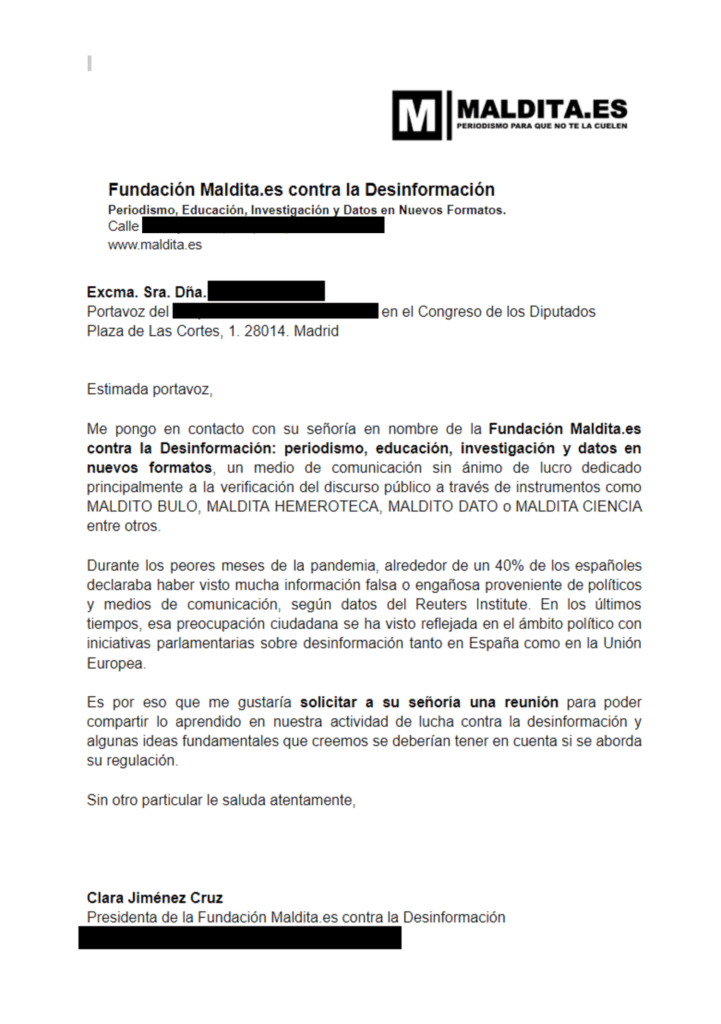
Here is the letter we have sent to all parliamentary groups and political parties with representation in the Congress of Deputies: