
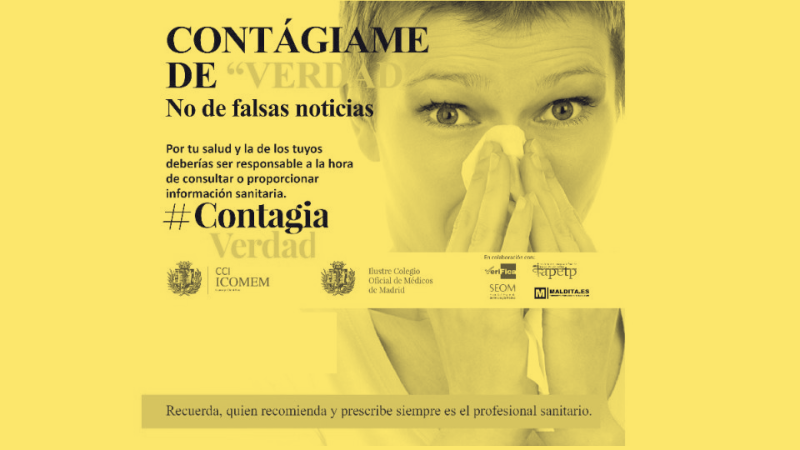
The initiative is part of the campaign “Contágiame de `verdad´, no de falsas noticias” with which the Scientific Council of ICOMEM draws attention to hoaxes and false health myths on the Internet, social networks and media outlets.
According to the Eurobarometer, in our country, almost eight out of ten Spaniards often come across news they believe distorts reality or is even false.
"SemanasICOMEM" to raise awareness among citizens, doctors and media
The “SemanasICOMEM” are dedicated this month of February to raising awareness among the public, the medical community and media outlets about the harm caused by false health information circulating online. The Scientific Council of the College of Physicians of Madrid emphasizes through the campaign “Contágiame de `verdad´, no de falsas noticias” the necessary control and monitoring to prevent false myths and hoaxes from continuing to spread.
As an initiative within this campaign, the College of Physicians of Madrid creates the Digital Observatory of health information in collaboration with EFE VERIFICA, MALDITA CIENCIA, APETP and SEOM, all of them entities that share the fight against false health information such as pseudotherapies or debunking hoaxes.
According to the Eurobarometer, in our country, almost eight out of ten Spaniards often come across news that are false; while across the European Union 68% of citizens say they identify this type of news. 52% of Spaniards and 58% of Europeans state that it is easy for them to detect false news. 83% of Spaniards and 76% of Europeans believe that this type of disinformation is a problem for democracy in general, and specifically almost eight out of 10 Spaniards believe it is a problem in our country.
For the president of the College of Physicians of Madrid, Dr. Miguel Ángel Sánchez Chillón, the joint launch of this campaign and the Observatory represents another step in ICOMEM’s determination to move away from pseudoscientific practices and pseudotherapies for the good of medical practice and people’s health. “We applaud and appreciate that these entities, which have been offering verified information with scientific rigor about health in digital media for some time, join the Scientific Council to work and rid professional medical practice of practices that lack the pertinent scientific rigor to treat and advise patients,” he states.
For his part, Dr. Jaime Barrio, specialist in Family and Community Medicine, member of SoMaMFyC and of the Scientific Council of ICOMEM, states that “it is essential to raise awareness among the public and healthcare professionals about the consequences their behavior online can have and the importance of responsible use of social networks and the Internet when consulting and providing health information. Therefore, with this campaign ICOMEM aims to promote the responsible use of the Internet and social networks to publicize where to consult reliable and quality health information, as well as help recognize the risks associated with health information provided by non-health personnel and non-official institutions.”
How will the Observatory work?
The four organizations that will collaborate with the College of Physicians of Madrid will be responsible for detecting and identifying practices that put people’s health at risk through false information. This content will be sent to the Scientific Council, which will be responsible for officially issuing its opinion on the matter. From now on, a form has been posted on the ICOMEM website where both the general public and registered members can submit complaints about malicious content.
SEOM, concerned about the impact that news about pseudosciences, substances, therapies, miracle products and ultimately about hoaxes and false health myths may have, has not hesitated to support this ICOMEM campaign. As commented by Dr. Álvaro Rodríguez-Lescure, president of SEOM, “in our Society we are committed to the dissemination of rigorous and truthful information, that does not generate false expectations or unfounded hopes or alarmism and that adheres to scientific rigor so that cancer patients can properly make their decisions.”
Elena Campos Sánchez, member of the Severo Ochoa Molecular Biology Center of UAM-CSIC and president of the Asociación para Proteger al Enfermo de Terapias Pseudocientíficas (APETP), calls on different social groups, professionals and local and regional governments to support this type of initiative, which should originate from each and every one of the entities dedicated to the generation and/or application of knowledge.
“It is necessary to continue moving forward with the Government Plan for the Protection of Health against pseudotherapies #CoNprueba, since these are nothing more than “fake news”, more or less amplified and equally harmful and, generally, with commercial intent. Likewise, Professional Colleges, like civil society, require the support of the regional Ministries and the Government to address this public health problem of false health news, which includes pseudotherapies,” she points out.
Access here the form to send the health hoaxes you detect.