
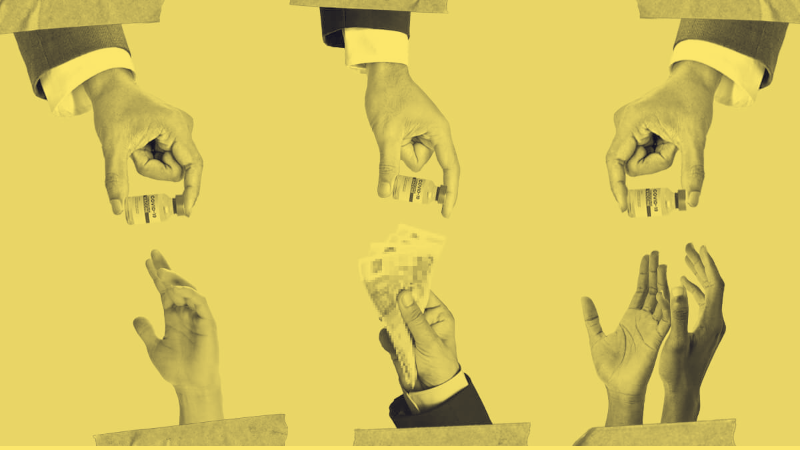
The Spanish Agency for Medicines and Health Products (AEMPS) has gone to court to keep hidden the Government’s agreements with other countries to resell or donate COVID-19 vaccines. A court will now have to decide whether this information should be public, as already ruled by the Transparency and Good Governance Council (CTBG) following a complaint filed by Maldita.es.
Maldita.es has formally appeared in the case to defend before the courts that this information must be public. The AEMPS, which depends on the Ministry of Health and is represented by the State Attorney’s Office, has filed an appeal before Central Administrative Court number 1 in Madrid. The co-defendants are the Transparency Council itself and us. Maldita.es will be represented by lawyer Samuel Parra, an expert in transparency, whose collaboration in this case we would like to thank.
Why should these agreements be public?
Mainly because we do not know how the Government has acted. With which countries has Spain signed agreements to deliver COVID-19 vaccines? How many of them were to donate doses and how many to resell them? Has the Government made money by reselling the vaccines or has it charged other States the same price it paid? These are three questions we would like to answer, and to this day the public does not know the answers. The information that Maldita.es requested through the transparency law, and that the Transparency Council has already considered public, would make it possible to answer them.
The Government does not want to disclose the agreements because it says doing so could harm its relations with other countries, but it has not explained how or why
In its response to Maldita.es’s request for information, the AEMPS argued that the agreements to sell or donate vaccines could not be made public because disclosure could “affect the overriding interest of protecting foreign relations”, since they involve a third country. However, the Transparency Council ruled that the Government had not provided “a reasonable and sufficient justification” for applying the limits it claimed, and ordered that the agreements be delivered to us. Instead of complying with the decision, the Government has appealed it in court.
Samuel Parra: “Citizens must be able to know under what criteria and conditions the resale of vaccines took place”
Samuel Parra, an expert in transparency, privacy and technology, and the lawyer collaborating with Maldita.es in this case, explains that “since the beginning of the pandemic there has been a certain lack of transparency in everything related to vaccines and the agreements or contracts with pharmaceutical companies”. “Citizens must be able to know under what criteria and conditions the resale of vaccines has taken place, or the details of the agreements reached between Spain and other countries to donate or resell vaccines. This is public information and part of the necessary scrutiny of public officials.”
Parra also refers to the first paragraph of the preamble of the transparency law, which states that “transparency and access to public information must be the fundamental pillars of all political action.”
Lack of transparency in dealings with pharmaceutical companies goes back a long way
In any case, this situation is not exceptional. Dealings between public administrations and the pharmaceutical industry have often been marked by opacity. At Maldita.es we believe that citizens have the right to know the prices at which governments buy medicines or vaccines, especially in a context such as the COVID-19 pandemic, where access to vaccines between rich and poor countries has been deeply unequal.
Although the agreements requested by Maldita.es are between Spain and third countries, they are linked to the prior purchase of vaccines by our country from pharmaceutical companies. These purchases were centralized and negotiated by the European Commission. There have been several controversies related to the lack of transparency, from the AstraZeneca contract that the Commission published with incorrect redactions, to the text messages between President von der Leyen and the CEO of Pfizer, which the European Ombudsman ruled should be public, but which Brussels still keeps hidden.